Dirt Shark Antenna
How a Humble Wire on the Ground Can Transform Your Radio Listening
Ever find yourself locked in a frustrating battle, wrestling with all those fancy knobs and buttons on your shiny radio to bring a signal out of the noise, just to catch a faint whisper from that station that started out copyable? Or that elusive DX station is sending a call that you just can't copy because the SNR is like 3-6 dB. You're not alone. Our primary antennas often become indiscriminate collectors – drawing in not only the desired signals but also a relentless barrage of buzzing, static, and digital hash. In our increasingly noisy world, the conventional antenna, while a decent transmitter, can become a veritable noise vacuum.
My Noisy, Old-Faithful 80m OCF
My homebrew 80m OCF has been a very good antenna for me at my QTH. I replaced my 40m OCF with it over 10 years ago. Ice and wind have broken its supports a few times over the years but it has continued to be a good performer for me on all bands except 30m. I still get regular reports where the receiving station is hearing me better than I'm hearing them.
Even with all that praise, it always has been subject to noise. The balun is supported by a rope connected at the apex of my roof, so it is right up against my home. My house is full of electrically noisy stuff, the worst of which is a treadmill worthy of an all-band WW2 radio jammer and a HVAC that has a noisy blower and gas furnace igniter that wipes out 5kHz segments on 20m in regularly spaced sections. My neighbors have something that turns on and off and gives me a nice S8 noise in segments across 40m and 80m, usually happening after I've begun a QSO.
I enjoy a challenge as much as anyone but I realized I could do better. I wanted an antenna optimized for receive rather than transmit.
Receive Only Antennas?
While researching, I read about a number of receive only antennas.
- Magnetic loops- Too fiddly to re-tune when you change bands
- Beverage - Give me land, lots of land
- LNA augmented, phased verticals - Money, money, money
- Loop on Ground - Cheap, but they can't possibly work
Loop on Ground Antenna
Enter an unlikely Receive Only Antenna, known as the "Loop-on-Ground" (LoG). It’s a marvel of minimalist design – nothing more than a simple loop of insulated wire. Its genius, however, lies not in boosting signals, but in not hearing noise.
Think of the LoG as a more approachable, compact cousin to the venerable Beverage antenna. Harold Beverage's experiments in the 1920s, involving long wires hugging the ground, revealed the potential for noise rejection and clear signal reception that the LoG continues to explore.
So why would 60 feet of wire oriented as a square, fed at a corner, pressed into the ground and covered by your lawn make a good receive antenna? Haven't we always been told that antennas work better, the higher they are?
A Loop on Ground (LoG) antenna rejects noise by primarily responding to the magnetic field of radio waves, not the electric field, making it less sensitive to common electrical interference from household devices (like TVs, computers, power supplies) that create strong electric fields. Its low-to-the-ground placement also helps it "see" less local electrical noise, effectively acting as a directional antenna with deep nulls, especially when oriented away from noise sources, significantly improving the Signal-to-Noise Ratio (SNR) for weak signals, according to KK5JY.Net.
How to Make One
The keys to the success of the antenna is making sure it is electrically isolated. Build a transformer using a binocular core with 5-6 turns (I used 6) of 30 AWG magnet wire connecting the wire and 2 turns going to the coax (instructions on KK5JY's site).
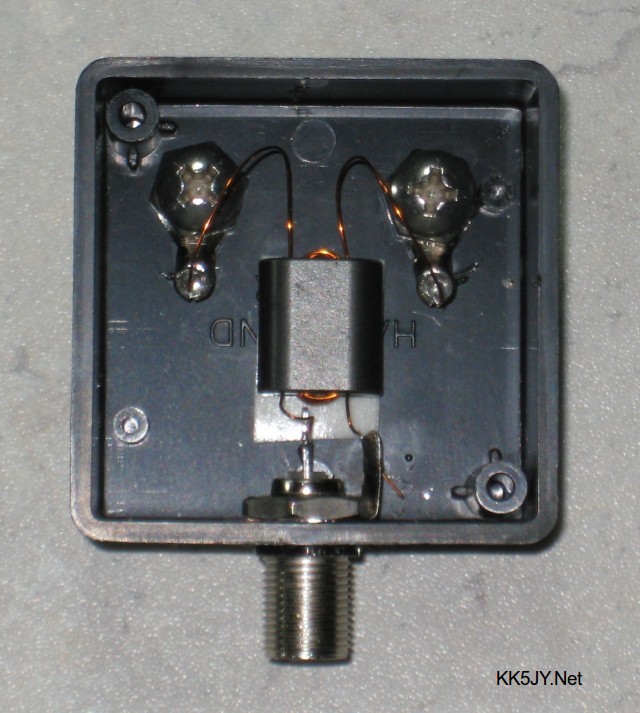
The coax thus becomes electrically isolated from the antenna. I forgot to take a picture before I sealed up the box with RTV but the photo above is from Matt's site. Stripping the enamel and soldering 30 AWG magnet wire is a challenge for me, especially in that small enclosure but I sorted it out. I filled my enclosure with RTV to secure the core and make it extremely difficult to work on in the future :)
I used 60 feet of my surplus, insulated telephone wire, bonded 2 stainless steel terminals to the ends and laid it out in the suggested pattern to align with my TX antenna. I have it placed about 25 feet away from my house in the back yard. It is about 50 feet away from my 80m OCF. It is secured using ground staples to hold the wire down into the grass. It literally disappears in the yard. I mean seriously disappears. I didn't have the transformer with me when I laid out the wire and stapled it, and when I came back out it took me 5 minutes to find the wire. You want to use a very small transformer enclosure so that it sits low in the ground so that your lawn mower won't destroy your hard work.

I used 75 feet of weather resistant RG6 75 ohm TV coax to get it back to my grounding point by the house where it goes into an arrestor before I use another 75 feet of coax to get it back up to my operating position.

I used coax seal on the connections both to the transformer and the arrestor.
Results
At my station I run it to my SDRPlay, using the SDR Antenna Switch and Front End protector I built 8 years ago.
I clearly see signals on the SDRUno display that don't even appear on my Yaesu FT-DX10 waterfall connected to the 80m OCF. The FT-DX10 has one of the best receivers in ham radio at this time, so it can dig those invisible signals out (barely) if I tune to what I see on the SDR, but if I switch to the audio from SDRUno they can be heard clearly.
Signals are being picked up by the LoG that are lost in the noise and are invisible on the waterfall of the FT-DX10 no matter how much I fiddle with the display gain and display peaking filters. But I can work them when I find them because that 80m OCF is a good performer as a TX antenna.
Similar to how I configured the SDRPlay to work with my Ten-Tec Eagle; SDRUno is feeding an IQ signal to CW Skimmer. CW Skimmer acts as my cluster server and my logging software shows me what I don't see on the Yaesu's waterfall. I click a station, either in CW Skimmer's display or from the cluster list and the FT-DX10 tunes to the station.
If I can't hear it on the DX10 it is a bit of a pain to turn off the IQ output from the SDR and send it's audio to a speaker rather than CW Skimmer, but I can work the station receiving on SDRUno and transmitting from the DX10.
Flipping the IQ on/off and changing the output is annoying so I have found a used DX-Engineering RTR-1A that I plan to put in series with the SDRPlay allowing the DX10 to listen on the LoG and transmit on the OCF, while protecting the SDR. I'll make a video showing the results when it arrives.

Conclusion
I had read mixed results from other hams on forums discussing using Loop on Ground antennas so my expectations were not super high. Maybe hams who aren't getting good results could try re-orienting their receive loops or maybe the transformer wiring could use improvements. Maybe they just don't have as much local noise as I do, but for my station this is a game changer.
While I've had mixed feelings about my DX10 I will admit that it hears and cleans up noise far better than my Ten-Tec Eagle and KX3 ever did, but I didn't know what I was missing. Since I had the waterfall on the DX10 I had stopped just slowly moving the VFO across the band. I would just tune to a signal I saw on the waterfall. I had no idea there was so much hiding in the noise.
"Now I see" said the blind man
That's all for now,
So lower your power and raise your expectations... Or build a receive only antenna and see what you were missing.
73 AA4OO

Now I know what you were talking about in our 40m QSO earlier today and it's a good reminder of some material I read some time ago about LoG. I've been tossing around some receive antenna ideas for my WebSDR as well. I'll put this one in my back pocket for further thought.
ReplyDeleteHope to work you 2xQRP some day.
73,
Phil K4NE